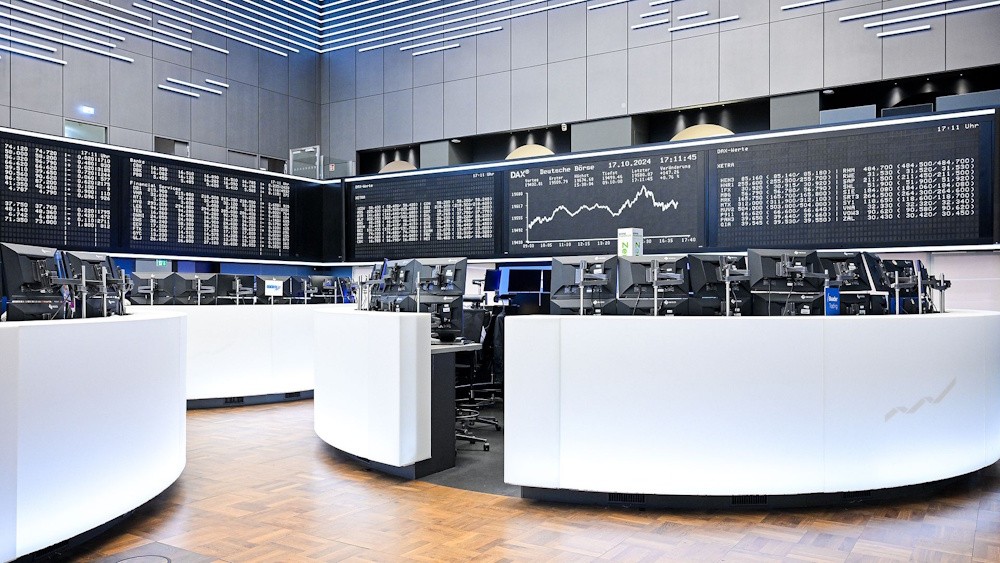
German stocks experienced a decline on Wednesday, driven by heightened inflation concerns following an increase in oil prices attributed to escalating tensions in the Middle East. Brent crude futures surged approximately 3% following reports that the U.S. military successfully intercepted Iranian missile attacks aimed at Bahrain, Kuwait, and various other regional sites. There exists significant ambiguity surrounding the negotiations between the U.S. and Iran, which are focused on concluding the conflict and facilitating the reopening of the Strait of Hormuz, an essential passage for the global energy market.
U.S. Secretary of State Marco Rubio stated that Iran has mined ‘large segments’ of the Strait of Hormuz, indicating that peace talks may extend over several months before reaching a conclusion. Rubio also informed the Senate Foreign Relations Committee that Iran’s supreme leader Mojtaba Khamenei remains alive and is becoming increasingly active at some level. The benchmark DAX experienced a decline of 272.76 points, reflecting a decrease of 1.09%, standing at 24,844.10 at noon.
- Deutsche Bank experienced a decline exceeding 4%.
- Fresenius experienced a decline of 3.2%, while Symrise saw a reduction of nearly 3%.
- Volkswagen, Mercedes-Benz, Rheinmetall, Scout24, Heidelberg Materials, and Porsche Automobil Holding experienced declines ranging from 2% to 2.6%.
- SAP, BMW, MTU Aero Engines, Deutsche Telekom, Continental, Gea Group, Vonovia, Adidas, Siemens Healthineers, Allianz, and Siemens experienced declines ranging from 1% to 1.9%.
- RWE experienced an increase of nearly 3%.
- E.ON and Zalando saw gains of 1.6% and 1.3%, respectively.
- Siemens Energy and Daimler Truck Holding recorded modest increases.
In recent economic developments, S&P Global’s data indicated that Germany’s Composite PMI was adjusted upward to 48.8 in May, up from a preliminary figure of 48.6 and compared to 48.4 in April. However, this still reflects a second consecutive month of contraction in private sector activity. The services sector PMI reading registered at 48.1 in May, an increase from 46.9 in April. Conversely, the manufacturing PMI recorded a value of 50.1 in May, a decline from 51.4 the previous month. The S&P Global Eurozone Composite PMI experienced an upward revision to 48.5 in May, an improvement from the preliminary figure of 47.5, and a slight decline from April’s reading of 48.8.
The Services PMI score registered at 47.7, a slight increase from 47.6 the previous month, whereas the manufacturing PMI recorded a figure of 51.6, down from 52.2 a month prior. Data indicated that producer prices in the Eurozone experienced a month-on-month increase of 0.6% in April 2026, subsequent to a notable 3.4% rise in March. In April, producer prices experienced an annual increase of 4.9%, marking the most significant rise since March 2023.