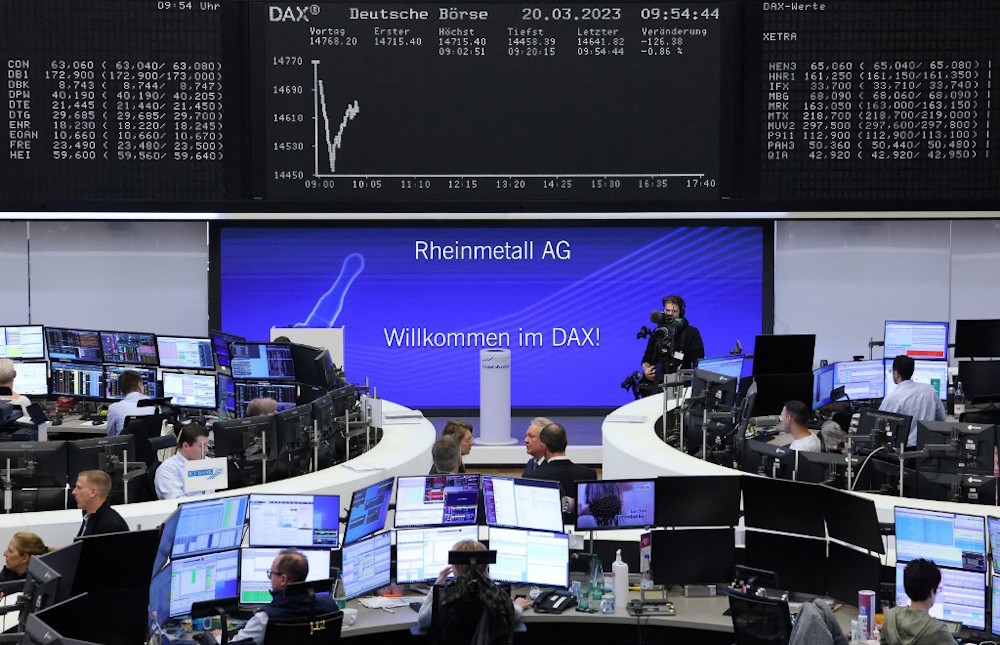
German stocks exhibited limited movement Wednesday morning as apprehensions regarding interest rates and a potential increase in tariffs, coupled with uncertainty surrounding returns on AI infrastructure investments, contributed to a cautious sentiment. Additionally, investors anticipated the pivotal U.S. PCE inflation data, which could influence the Federal Reserve’s policy decision.
The German economy experienced only a slight expansion in the third quarter, as indicated by official data released on Wednesday, reflecting subdued growth in household spending and a significant decrease in investment. The benchmark DAX, having fallen to 24,953.48, subsequently rebounded to 25,154.73 before settling at 25,013.91, reflecting an increase of 8.40 points or 0.03%.
- Volkswagen experienced a surge of over 6% following the conclusion of the initial round of labour negotiations, which did not result in an agreement.
- BMW experienced an increase of 4.5%, while Mercedes-Benz saw a rise of 4.2%, and Daimler Truck Holding recorded a gain of 3%.
- Heidelberg Materials experienced an increase of 3.2%. Vonovia experienced an increase of nearly 3%, whereas Continental, Beiersdorf, and Rheinmetall saw gains ranging from 1.8% to 2.2%.
- Brenntag, Henkel, Adidas, Symrise, and Deutsche Post experienced significant upward movement.
- Bayer experienced a decline of 3.2%. Infineon Technologies declined by 2.1%, continuing the downward trend observed in the prior session. RWE and Scout24 experienced declines of 1.6% and 1.3%, respectively.
- Siemens Energy, Deutsche Boerse, SAP, Commerzbank, Hannover RE, and Deutsche Bank experienced declines ranging from 0.4% to 1%.
Data released by the Federal Statistical Office Destatis indicated that Germany’s gross domestic product recorded a quarterly growth of 0.1% in the third quarter, a revision from the initial estimate of 0.2%. This followed a 0.3% growth in the second quarter. Calendar adjusted GDP increased by 1.1%, outpacing the 1% growth recorded in the second quarter.
Nonetheless, the growth for the third quarter was revised downward from 1.2%. The annual growth in price-adjusted GDP has been revised down to 1.2%, a decrease from the previous estimate of 1.3%. The expenditure-side of GDP indicated that final consumption expenditure increased by 0.1% compared to the preceding quarter. Household spending, representing approximately 70% of total final consumption expenditure, increased by a mere 0.1%. Government expenditure increased by 0.3%.