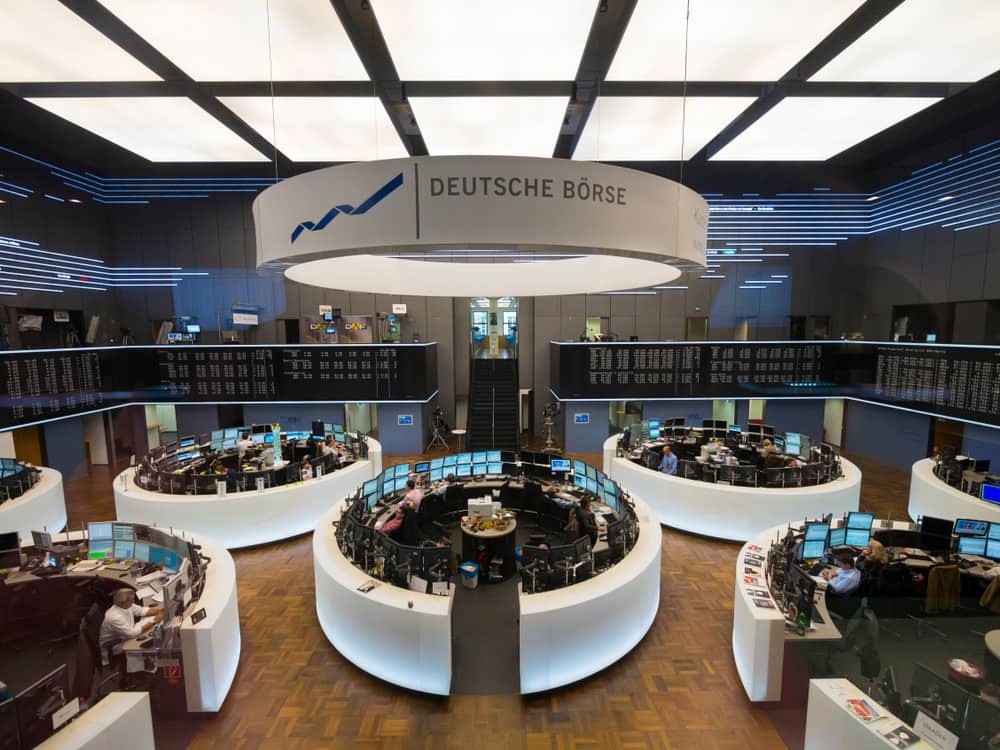
Following a sluggish beginning, the German stock market experienced an upward movement on Monday morning, with several stocks garnering increased buying interest. The market sentiment exhibited a degree of caution as investors anticipated the forthcoming monetary policy announcement from the European Central Bank. Geopolitical concerns persist as Iran has issued a warning regarding a potential escalation in tensions should the U.S. initiate an attack. Commodity-Related stocks faced downward pressure, influenced by declining metal and energy prices. The benchmark DAX, which fell to 24,339.16 in early trades, increased by 101.21 points or 0.41% to reach 24,616.94 just before noon.
- Adidas experienced an increase of approximately 2.3%, while Hannover Rueck saw a rise of 2%.
- Deutsche Telekom and Allianz experienced increases of 1.85% and 1.7%, respectively.
- Fresenius experienced an increase of 1.4%.
- Gea Group, Munich RE, SAP, Henkel, and Commerzbank experienced increases ranging from 1% to 1.15%.
- E.ON, Fresenius Medical Care, Heidelberg Materials, Beiersdorf, and Mercedes-Benz recorded slight gains.
- Rheinmetall, Brenntag, Infineon Technologies, and Siemens Energy experienced declines ranging from 1% to 1.7%.
- Symrise experienced a decline of 0.7%, while Deutsche Bank, Bayer, and Volkswagen also saw slight decreases.
Data indicated that retail sales in Germany experienced a 0.1% increase on a month-over-month basis in December, effectively reversing the 0.5% decline observed in November. Sales were projected to increase by 0.1%. Retail sales experienced an annual growth rate of 1.5%, reflecting an increase from the 1.3% observed in November. In January, the contraction in manufacturing activity within the euro area decelerated, with production experiencing a rebound, according to the final survey results. The final HCOB manufacturing Purchasing Managers’ Index increased to 49.5 in January, up from a nine-month low of 48.8 recorded in December. The preliminary reading registered at 49.4.
The score has consistently registered below 50.0 for the third consecutive month in January, signaling a contraction in the sector. Germany’s manufacturing sector experienced a sustained contraction for 43 consecutive months as of January. Nonetheless, the final factory PMI increased to a three-month peak of 49.1 in January, up from 47.0 in December, as production resumed its growth trajectory following a temporary decline in December. The preliminary PMI reading for January stood at 48.7.